Image


With the holidays quickly approaching, many hosts are thinking about what to serve at their next gathering. We spoke with New York City-based beverage consultant Melissa Brooke to get the scoop on what to have on hand to make a great cocktail, her favorite drinks for fall and the holiday season, and her unique Astro-Herbal Experiences. Brooke’s extensive background working in top cocktail bars, nightlife spots, and Michelin-starred restaurants, combined with her current role as an expert judge on E!’s cocktail competition show, Cocktail Wars (with celebrity co-hosts Lance Bass and Joey Fatone), make her the perfect person to help you create a great cocktail this holiday season and beyond.
When it comes to cocktails, Brooke cautions that less is more, saying that the classic drinks are still popular for a reason. “I think it is important to acknowledge that we are not always trying to reinvent the wheel, but rather add some extra spokes along the way,” Brooke says.
You don’t have to be a professionally trained bartender to make a good cocktail, either. Brooke’s top tip is to avoid free-pouring, suggesting instead to follow measurements closely (called “jiggering” in the cocktail world). “Jiggering your cocktails, just like you would follow instructions to measure ingredients when baking a cake, is a huge key to home bartenders creating cocktails that are well-balanced,” Brooke tells us. “Even a seemingly simple three-ingredient cocktail like a Negroni depends on precise proportions.” Beyond precise measurements, ingredient quality, temperature, dilution, and technique all play a role in creating a well-balanced cocktail.
Personalization goes a long way, too. “If you’re creating a cocktail for someone’s birthday, giving it a meaningful or sentimental name and incorporating an ingredient that reflects their personality can make it that much more memorable,” says Brooke. “Small nods of attention can be as simple as choosing appropriate glassware, a thoughtful garnish, a chilled glass, or even creating a small cocktail menu for guests.”
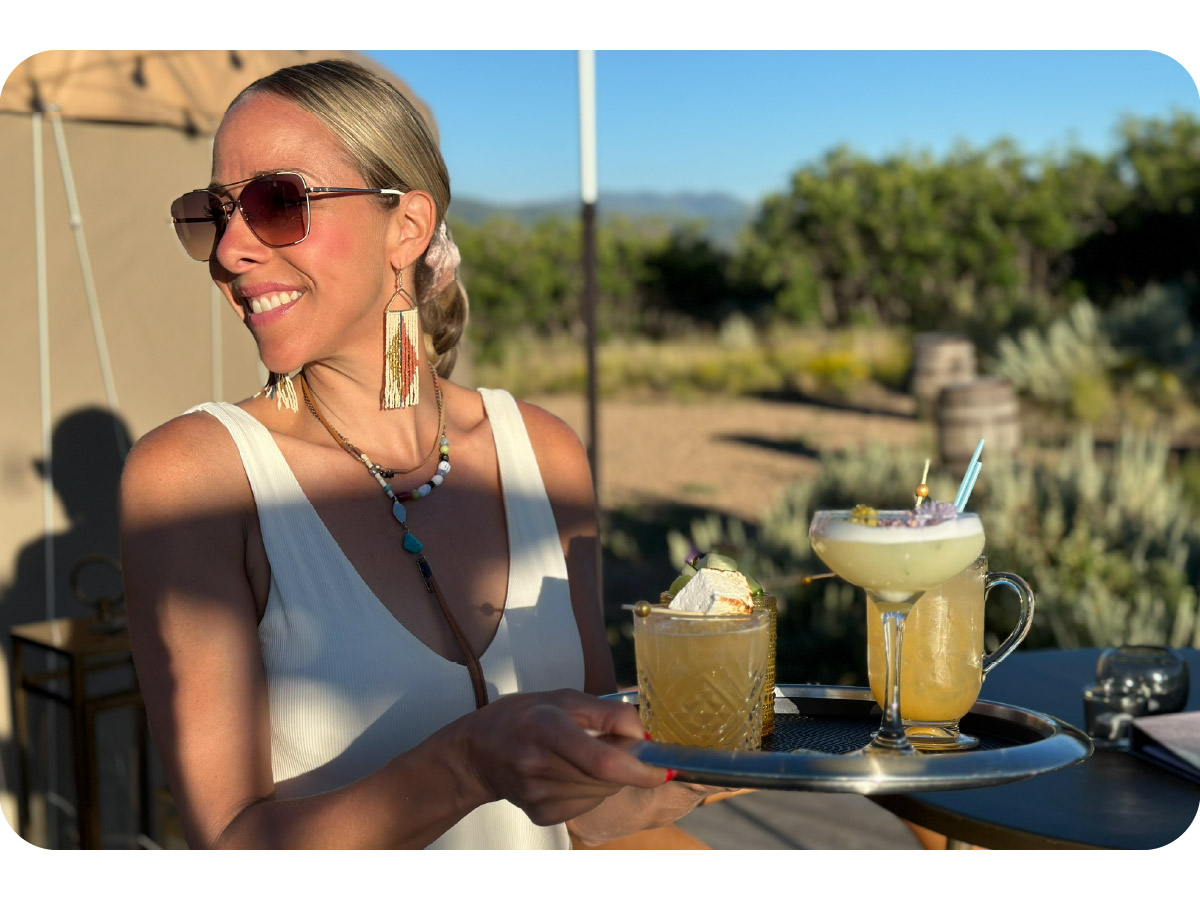
More good news for creating cocktails at home: you don’t have to have an entire bar at your disposal to make a good drink. What you stock depends on a couple of different factors, Brooke tells us, suggesting to consider who you’re creating the bar for and how you plan to use it first. For example, are you serving yourself a nightcap every evening, or building a bar for entertaining friends and guests?
“I tend to think about a home bar in the same way I think about a bartender’s back-pocket ingredients: the foundational elements that allow you to create a variety of cocktails without needing an endless selection of bottles,” Brooke says.
Key Ingredients for Your Home Bar:
Essential Tools for Your Home Bar.
With a few essential ingredients and tools on hand, fall and the holiday season are a great time to experiment with seasonal cocktails. “For the fall season, it’s easy to infuse a simple syrup with baking spices and use it as an all-purpose sweetener,” Brooke says. “Simple syrup, at its core, is made with equal parts white granulated sugar and water by volume.”
How to Make Spiced Simple Syrup:
An Easy Fall Cocktail Base:
Directions:
“The beauty of this recipe is that it is relatively inexpensive to make, uses readily available ingredients, and serves as a great starting point for experimentation,” Brooke says. “It follows the basic structure of a sour cocktail, with a base spirit, citrus, and sweetener, while the apple cider adds a seasonal element.”
Brooke also encourages home bartenders to experiment with different spirits, adjust the balance of sweetness and acidity, and add layers of flavor with bitters, herbs, or liqueurs. Her advice is to change one variable at a time and taste as you go to see how small adjustments can transform a drink.

When thinking about what to serve for Thanksgiving, holiday gatherings, and New Year’s celebrations, Brooke recommends focusing on fresh, in-season ingredients and the occasion itself. “The stretch from Thanksgiving through New Year’s is filled with themes of abundance, gratitude, generosity, reflection, and celebration,” Brooke tells us. “I love exploring how ingredients, aromas, temperature, and presentation can help communicate those feelings.”
Brooke points to a Hot Toddy, which she says is much more than a warm drink on a cold day. “The warmth of the liquid, combined with the comforting character of honey and perhaps the addition of ginger and baking spices, creates a sense of comfort and conviviality that feels particularly appropriate for the season,” says Brooke. “A completely different experience might come from a bright, sparkling beverage with fresh citrus and aromatic herbs, offering a celebratory feel. Whether a drink contains alcohol or not, I approach its development with the same attention to balance, sensory experience, and intention.”
When it comes to the holiday season, one of the challenges is that you’re not always making a cocktail for an individual or even a few guests. So, how can hosts prep ahead of time without spending the entire gathering behind the bar instead of enjoying the event? When it comes to creating cocktails for a group, Brooke recommends batching certain ingredients. While batching spirits ahead of time is fine, Brooke suggests caution against batching fresh juice, as it loses its brightness with time, and says to focus on using freshly squeezed juices instead.
Brooke points to pre-dilution as another helpful technique. “This involves adding a calculated amount of water to a batched cocktail in advance to account for the dilution that would normally occur during shaking or stirring,” Brooke says. “The batch can then be chilled and served without having to prepare each drink individually. These are common practices in professional bar programs and can produce excellent results when the recipe, dilution, and storage conditions are carefully managed.”
Brooke recommends testing batched cocktails in advance to find the right amount of dilution for each recipe and serving method. Punches and stirred cocktails tend to work well for batching, while sparkling drinks and cocktails that rely on a freshly shaken texture are often better prepared to order.
As the new year approaches, many people turn their attention to astrology and what’s in store for the year ahead. In addition to creating cool cocktails, Brooke is known for her unique Astro-Herbal Experiences, which blend astrology, herbs, and cocktails.
“I have always loved the artistry of working with botanicals in cocktails and exploring how they interact with one another and with different spirits,” Brooke explains. “I began diving into the practice of herbalism and found myself down a spiritual rabbit hole exploring the history and meaning of plants, roots, herbs, flowers, and spices. I love the idea that everything we consume can have a meaning if we choose to let it.”
Brooke brings these interests together by using associations between botanicals, planetary energies, zodiac signs, and elemental themes to inform the ingredients and intentions behind each experience. Depending on the occasion, that might mean cocktails inspired by astrological transits, ingredients connected to zodiac signs, or collaborations with tarot, oracle, or aura readers.
“Each experience is different, shaped by the gathering, the setting, and the story we want to tell,” Brooke says. “The common thread is an exploration of how ingredients can carry meaning beyond flavor alone.”
The Related Life is written and produced by the Related Life Editorial Team. Be sure to follow us on Facebook and Instagram for the latest events, news, and announcements in your area, and tag us for a chance to be featured @therelatedlife and #therelatedlife.